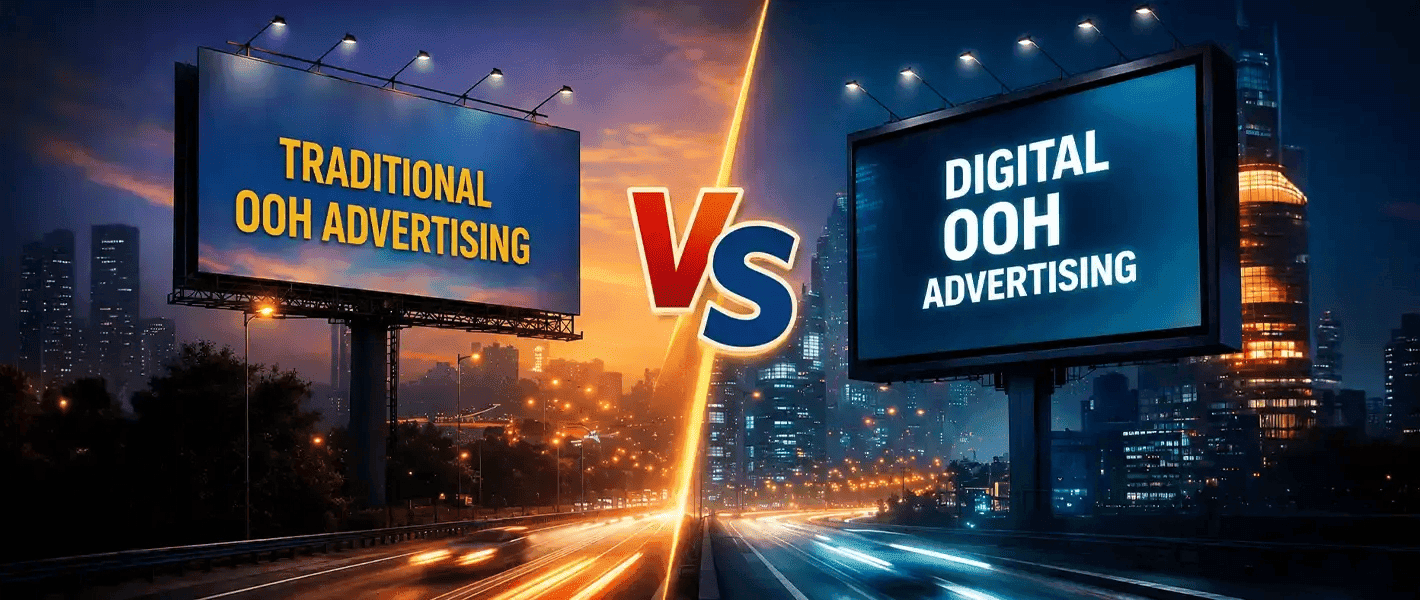
DOOH Advertising: What It Is, How It Works, and Why It Drives Real Results
Explore how DOOH advertising works, why it’s becoming a key part of modern marketing strategies, and how brands can use the right locations, formats, and creatives to drive stronger visibility and audience engagement.
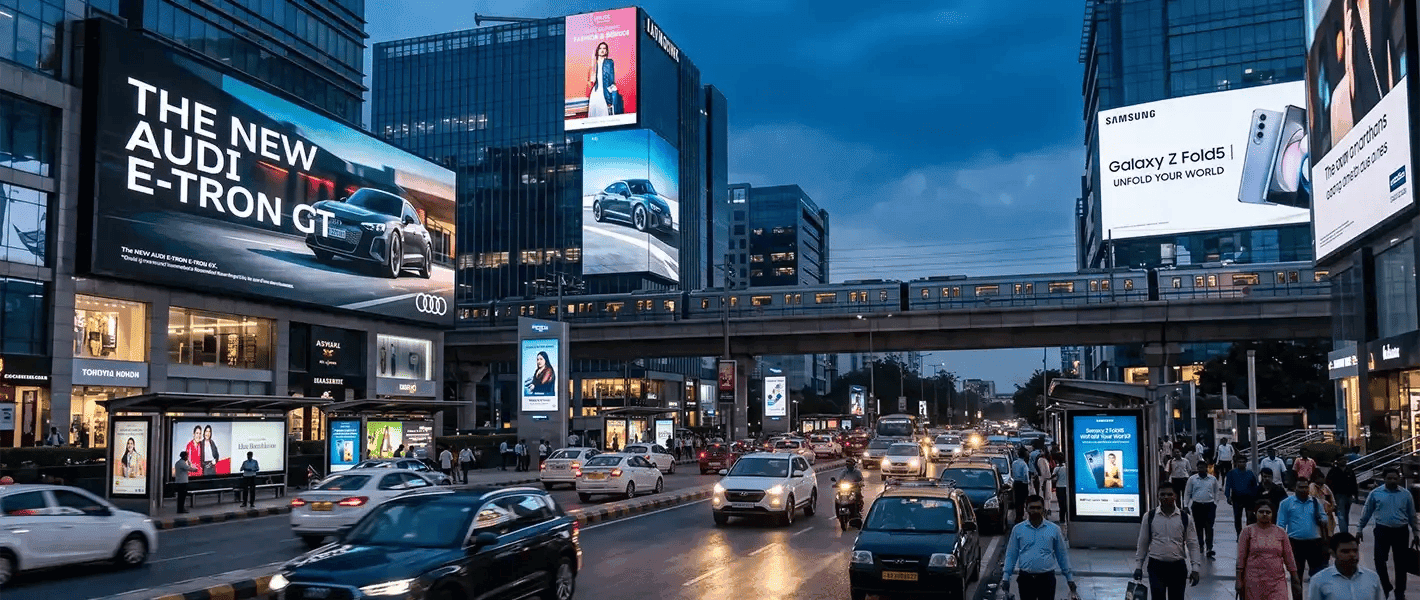
Attention has become harder to earn online, but easier to hold in the real world. DOOH advertising combines the impact of outdoor visibility with the flexibility of digital media, helping brands stay relevant, dynamic, and visible across the places audiences pass through every single day.
What Is DOOH Advertising?
DOOH advertising — short for Digital Out-of-Home advertising — is outdoor advertising displayed on digital screens in public spaces rather than static printed boards.
Unlike traditional hoardings or banners, DOOH screens show moving visuals, rotating creatives, and time-sensitive messages. A single screen can display breakfast offers in the morning, lunch deals at noon, and evening promotions after 5 PM — all without a single physical change.
You'll find DOOH screens at:
Metro stations and bus shelters – high dwell time, repeated daily exposure
Highways and flyovers – fast-moving audiences, bold messaging required
Shopping malls – lifestyle-driven audiences in a buying mindset
Airports – premium, high-income demographic
Market areas and high streets – local, high-footfall consumer traffic
DOOH is growing fast. Programmatic DOOH ad spend is projected to reach $1.23 billion USD by 2026, growing at 23% year over year — driven by brands seeking audiences that can't be reached through digital-only campaigns.
Why DOOH Advertising Works
People skip digital ads. They use ad blockers, scroll past banners, and mute pre-roll videos. But they cannot scroll away from a screen at a metro exit or a highway junction.
According to a 2024 survey by The Harris Poll (commissioned by OAAA):
73% of consumers view DOOH ads favorably — significantly higher than TV (50%), social media (48%), and print (31%)
76% of people took action after seeing a DOOH ad — including store visits, online searches, or purchases
74% of mobile users went online after seeing a DOOH ad, visiting websites or searching for the brand
80% of viewers are more likely to act when DOOH ads are visually bold and creative
This makes DOOH one of the highest-performing awareness and action-driving formats in the current media mix.
DOOH vs. Traditional OOH: What's the Difference?
DOOH does not replace traditional OOH entirely — large static billboards still hold value for long-term brand presence. But for campaigns that need flexibility, relevance, and impact, digital OOH delivers more.
How DOOH Advertising Works Behind the Scenes
DOOH campaigns are managed through connected content management systems (CMS) linked to networks of outdoor screens. Here's how a typical campaign runs:
Screen selection – Locations are identified based on audience profile, footfall data, and campaign goals
Creative scheduling – Ads are scheduled remotely, rotating across different brands and time slots
Dynamic content triggers – Advanced setups can trigger ads based on time of day, day of week, or external data
Campaign monitoring – Visibility reach and delivery data are tracked through the platform
Performance analysis – Post-campaign, results are assessed using reach, recall studies, and downstream search or sales lift
This infrastructure is what separates DOOH from a simple "digital billboard" — it's a managed media channel with measurable performance.
Location Strategy: Why Placement Matters More Than You Think
In DOOH advertising, where your ad runs is often more important than what it says.
A compelling creative in the wrong location will be wasted. A simple but well-placed message in front of the right audience can outperform a polished campaign with poor placement.
Strategic placement depends on:
Daily footfall volume – How many people actually pass this screen?
Audience composition – Are they students, office workers, travelers, families?
Dwell time – Is the audience moving fast (highway) or waiting (metro platform)?
Proximity to purchase – Is the screen near a store, mall entrance, or service point?
Placement examples by business type:
Food & beverage brands → Office zones and metro stations during commute hours
Retail and fashion → Mall entrances, high streets, lifestyle hubs
Fintech and apps → Metro cities, business districts, airport terminals
Real estate → Key arterial roads, residential entry points
Local services → Neighbourhood high-footfall markets and junctions
This is why good DOOH planning is audience mapping in the physical world — not just media buying.
What Makes DOOH Ads Effective: Creative Principles
The human brain processes outdoor screens differently from digital ones. People have 3–5 seconds of attention at most.
Creatives that perform well:
Single, clear message — one idea per screen
Large, high-contrast text (minimum 3-word headline if possible)
Bold visuals with clear brand identity
Minimal clutter — plenty of negative space
Strong colour contrast that works in bright daylight
Creatives that underperform:
More than one message or offer
Small text or complex visuals
Low contrast that fades in sunlight
Too many elements competing for attention
A useful test: if a 10-year-old can't understand your ad in 3 seconds, it's too complicated for outdoor screens.
DOOH as Part of a Larger Marketing Strategy
DOOH works best when it's coordinated with your broader marketing plan. It is particularly strong for:
Brand awareness campaigns – Building recognition across a geographic area
New product or service launches – Creating visible, real-world presence during launch windows
Retargeting support – Reinforcing digital campaigns with physical-world visibility
Local market activation – Driving foot traffic to specific outlets or areas
Top-of-funnel reach – Reaching audiences who are light digital media users
Research shows that DOOH combined with search campaigns drives significant search lift — meaning consumers exposed to outdoor screens are more likely to search for your brand online afterward.
Common Mistakes Brands Make With DOOH
Even well-funded campaigns underperform when these mistakes are made:
Choosing locations based only on cost – Cheap placements in low-footfall areas deliver poor results regardless of creative quality
Running campaigns too briefly – A 5-day burst rarely builds meaningful recall; outdoor advertising benefits from sustained exposure
Cramming too much into the creative – Outdoor is not the place for terms and conditions or product lists
Treating DOOH as an isolated channel – It works best when supporting or reinforcing digital and search activity
Ignoring audience context – An ad for premium real estate running near a college campus is a targeting mismatch
How Rahane Media Plans DOOH Campaigns
Rahane Media approaches DOOH advertising with a focus on planning clarity and audience relevance — not just filling screen inventory.
The planning process:
Audience mapping – Understanding where your specific audience actually moves day-to-day
Location scoring – Evaluating screens based on footfall, dwell time, and audience fit
Creative guidance – Advising on messaging that works for outdoor formats
Campaign scheduling – Planning duration and timing for maximum recall
Performance visibility – Tracking delivery and impact throughout the campaign
Whether you are running your first DOOH campaign or scaling an existing outdoor presence, the focus is on meaningful visibility, not just impressions.
Is DOOH Right for Your Business?
DOOH advertising is a strong fit if:
You want to build brand awareness in a specific city, area, or corridor
Your audience spends time commuting, shopping, or traveling
You're launching something new and need real-world presence fast
Your digital campaigns need physical reinforcement
You are a local business that wants neighbourhood-level visibility
It is less suited to highly granular conversion-focused campaigns where precise 1:1 targeting is essential — that's more the territory of performance digital advertising.
Get Visible Where Your Audience Actually Is
Your customers move through the real world every day — past junctions, through malls, across metro stations. DOOH advertising puts your brand in those moments.
Ready to plan a campaign?
Explore screen locations relevant to your audience
Get a visibility plan tailored to your market
Understand where your customers actually move
Launch a digital OOH campaign with a clear strategy
Questions Brands Commonly Ask
Quick answers about billboard advertising, media locations, and campaign planning.
What does DOOH stand for?
Digital Out-of-Home — advertising on digital screens in public spaces instead of printed hoardings.
How is DOOH different from a regular digital billboard?
A digital billboard is one screen. DOOH is a managed network of screens with scheduling, targeting, and performance tracking built in.
What does DOOH advertising cost in India?
It depends on location, screen quality, and duration. High-traffic metro spots cost more. Rahane Media can share location-specific estimates based on your goals.
Ready to Launch Your
Campaign?
Partner with Rahane Media and take your brand visibility to the next level with outdoor advertising.