OOH vs DOOH: What Is the Difference and Which Should You Choose?
OOH and DOOH both put your brand in front of people on the move — but they work very differently. Here's a clear breakdown to help you pick the right format for your next outdoor campaign in India.
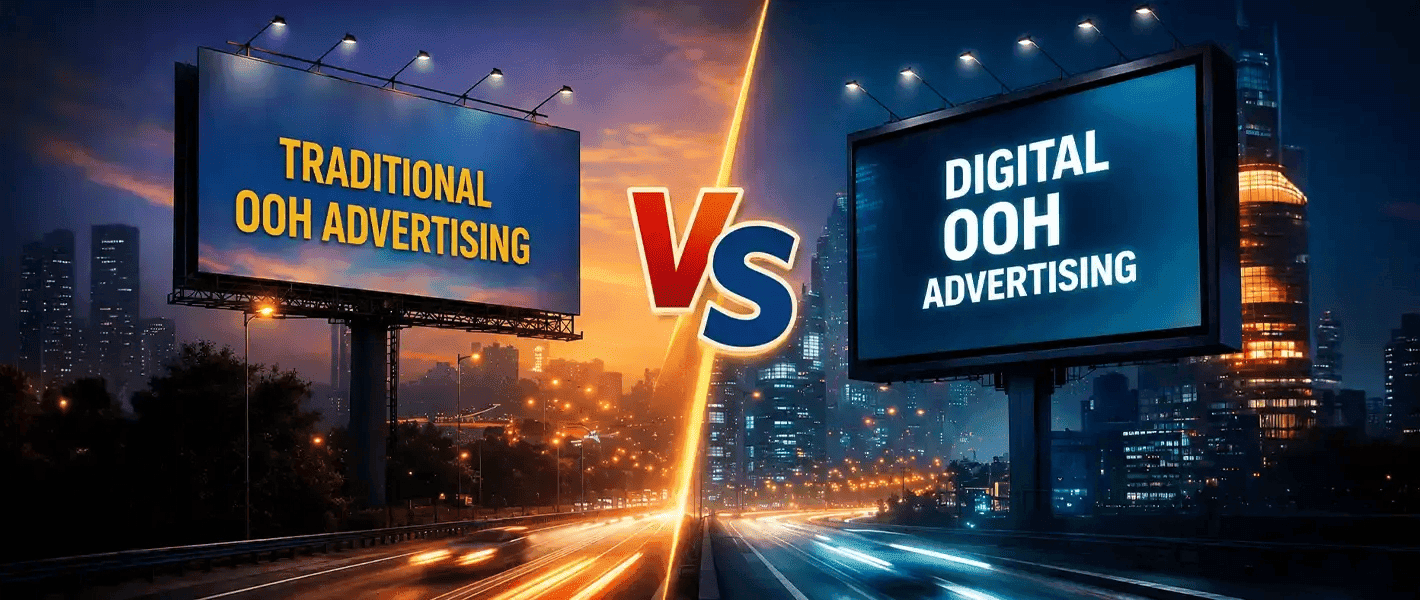
OOH (Out-of-Home) is all outdoor advertising — hoardings, transit ads, metro branding. DOOH (Digital Out-of-Home) is outdoor advertising delivered through LED screens instead of printed panels. Both reach people outside their homes; only one uses electricity.
That is the short answer. But if you are planning an outdoor campaign in India and trying to decide between booking a hoarding and buying time on a digital screen, the difference matters a great deal — in cost, in how your creative works, in which cities you can actually reach, and in how fast your campaign goes live.
This guide explains exactly how OOH and DOOH differ, where each format makes sense in India, and how to decide which belongs in your next campaign.
OOH vs DOOH at a Glance
The most important thing to understand: DOOH is a subset of OOH. Every DOOH screen is an OOH medium. But a printed hoarding on the Delhi-Jaipur highway is not DOOH. The difference is the screen.
What Is OOH Advertising?
OOH stands for Out-of-Home advertising — any paid advertising that reaches people when they are outside their homes. It is one of the oldest forms of advertising and still one of the most widely used in India.
In India, OOH includes highway and city hoardings, auto rickshaw hood and back branding, bus shelter panels, metro pillar and station branding, mall facades, kiosks, and street furniture.
OOH is sold on a per-location, per-duration basis. You book a specific site — say, a 40×20 ft hoarding at Bandra Kurla Complex for 30 days — a vinyl creative is printed and physically installed at that location. For the entire duration of your booking, that panel shows your brand and nothing else.
For a detailed guide to all OOH formats, how campaigns are bought, and what to expect in India, read: OOH Ads Explained: What Outdoor Media Is, How It Works and What It Costs.
What Is DOOH Advertising?
DOOH stands for Digital Out-of-Home advertising. It is OOH delivered through a digital LED or LCD screen rather than a printed panel.
Instead of printing a vinyl, you upload a digital creative — a static image, an animation, or a short video — to a screen management system. The screen runs your ad in rotation with other advertisers. A typical loop on an Indian DOOH screen cycles through 4 to 6 brands, giving each brand an 8 to 12 second slot per rotation.
DOOH full form: Digital Out-of-Home. It is not a competing category — it is a technology-driven branch of OOH that uses screens instead of print.
Think of it this way: OOH is the canvas. DOOH is what happens when you replace the canvas with a television.
In India, DOOH screens currently exist at airports, Delhi Metro stations, high-footfall malls in tier-1 cities, and major arterial roads in Mumbai, Delhi, Hyderabad, and Bengaluru. More on this below.
Some DOOH screens also support programmatic buying — where ad slots are purchased through an automated platform with time-of-day targeting, audience data triggers, and real-time bidding — similar to how you buy Google Display ads. This is still early-stage in India but expanding steadily.
Is DOOH More Expensive Than OOH?
A common question — and the answer is not straightforward.
The cost per screen for DOOH is generally higher than for a comparable static hoarding. A prime LED screen in a Delhi Metro station or Mumbai airport will cost more per month than a printed hoarding in the same vicinity.
However, because DOOH screens are shared across multiple advertisers, the cost per impression can actually be lower. You are not paying for 100% ownership of a panel — you are paying for a share of a high-traffic digital surface.
For most Indian businesses, traditional OOH remains the more accessible entry point. A roadside hoarding in a tier-2 city like Jaipur or Lucknow can be booked for ₹15,000 to ₹40,000 per month. Quality DOOH inventory in metro markets typically starts higher.
For a full breakdown of costs by format and city, see: Billboard and OOH Advertising Cost in India.
6 Key Differences Between OOH and DOOH
1. Creative flexibility
This is where the gap between the two formats is widest.
With traditional OOH, your creativity is fixed the moment it is printed. Spot a typo, need to update a price, or want to react to something in the news? You are reprinting and reinstalling — which costs money and typically takes 7 to 14 days.
With DOOH, you update creatively from a laptop. Swap the headline, change the offer, or upload an entirely different ad to the same screen within hours. A quick-service restaurant chain, for example, can run a breakfast creative on the same screen from 7am to 11am and automatically switch to a lunch promotion from noon — without any physical intervention. A sale-driven brand can update its discount figure the moment a flash sale launches at midnight.
For campaigns with a single strong idea that will not change, the flexibility advantage of DOOH matters less. For campaigns that need to react, iterate, or run multiple messages, it is significant.
2. Audience targeting
Traditional OOH targets by location. You select the site; you reach whoever passes it.
DOOH adds targeting layers that static print simply cannot offer:
Time of day — a gym ad at 6am, a restaurant at 7pm, on the same screen
Day of week — different messaging on weekdays versus weekends
Audience signals — platforms can use anonymised mobile data to understand the profile of people who regularly pass a given screen
Contextual triggers — temperature-activated creative (a cold drink brand activating only when it is above 35°C), or IPL score-responsive ads during a match
One honest note for Indian marketers: the sophisticated audience data layering available in the US and UK is not uniformly available across Indian DOOH screens yet. The infrastructure is developing, and capabilities vary significantly by media owner and location. Set realistic expectations when buying DOOH in India — location and time-of-day targeting is reliable; deep demographic layering is still maturing.
3. Share of voice
This nuance catches many first-time DOOH buyers off guard.
When you book a traditional OOH hoarding, you own that panel completely. Every person who passes that site, every minute of every day for 30 days, sees your ad and only your ad.
With DOOH, you are buying slots on a screen shared with other advertisers. A typical loop runs 4 to 6 brands, each appearing for 8 to 10 seconds. If you are one of five brands, your ad appears roughly once every 50 seconds.
This is not inherently a problem — it lowers the cost per impression and the shared economics make DOOH accessible. But it fundamentally changes how creative must work. A DOOH ad has 8 seconds to land. No long copy. No detailed product shots. One clear message, one clear visual, one clear call to action.
If your brand message requires reading time or context, OOH — where your hoarding sits for the full campaign duration — will serve you better.
4. Campaign speed
From brief to live, a traditional OOH campaign typically takes 7 to 14 days. Creative needs to be finalised, approved, sent to print, and physically installed across all booked locations. For large campaigns spanning multiple cities, coordination adds further time.
DOOH compresses this to 24 to 48 hours after creative approval. For product launches, time-sensitive offers, IPL season activations, or reactive marketing — where being first matters — this speed advantage is real and meaningful.
5. Measurement
Neither OOH nor DOOH offers the granular, real-time measurement of Google or Meta. But DOOH gets closer.
Traditional OOH measurement relies on footfall counts, traffic data, and estimated impressions — all approximations. Brand recall surveys remain the most reliable way to measure whether a static OOH campaign actually moved the needle.
DOOH screens can log how many times an ad was served. More advanced platforms integrate with mobile location data to estimate how many people saw a screen and later visited a store or searched for a brand. This is imperfect, but more data-rich than static OOH.
For both formats, measurement in India is still less advanced than in mature Western markets. Account for this when setting campaign KPIs.
6. Geographic reach
This is the most practically important difference for Indian marketers in 2025.
Traditional OOH is available everywhere — every metro city, every tier-2 and tier-3 town, every highway, every auto-rickshaw market. If your campaign needs to reach Bhopal, Surat, Vizag, or rural Rajasthan, OOH can get you there.
DOOH, as of now, is a metro and airport medium. It is strong in Delhi, Mumbai, Bengaluru, Hyderabad, and Chennai — particularly at airports, metro stations, and premium malls. Outside these markets, DOOH inventory is sparse or non-existent.
If your audience lives and works outside India's top five cities, traditional OOH is not just the cheaper option — it is often the only outdoor option available.
Common Myths About OOH and DOOH
Myth: DOOH will replace OOH. Static OOH still accounts for the large majority of outdoor advertising spend in India and globally. Building and maintaining a digital screen costs significantly more than installing a printed panel. Both formats will coexist for the foreseeable future — the choice between them is strategic, not generational.
Myth: DOOH is too expensive for small or mid-sized brands. Because costs are shared across multiple advertisers, the cost per impression on a DOOH screen can actually be lower than a dedicated static panel. A focused DOOH campaign at a single high-footfall location — a mall entrance or metro concourse — is accessible at meaningful budgets.
Myth: OOH cannot be measured.Traditional OOH is measurable — through footfall data, traffic counts, QR code tracking, unique promo codes, and brand recall surveys. It is not as granular as digital, but it is far from a black box. Many Indian brands use location-specific QR codes on hoardings to track inbound traffic directly.
Myth: With DOOH, I can change my ad in real time, whenever I want. Creative changes on a DOOH screen still require approval from the media owner and a technical upload process. You have far more flexibility than static OOH, but real-time unlimited changes are not the norm. Factor in a 24-hour lead time for any creative update.
Myth: DOOH is available all across India. Currently, DOOH is concentrated in metro cities, airports, and select high-footfall venues. If your market is outside the top five cities, traditional OOH is your primary and often only outdoor option.
Where Is DOOH Available in India Right Now?
Before you decide to go DOOH, the first practical question is whether it can actually reach your audience.
Airports are India's most mature DOOH environment. Delhi IGI, Mumbai CSIA, and Bengaluru Kempegowda have extensive screen networks across check-in halls, departure lounges, and arrival areas. Captive, dwell-heavy audience — ideal for premium brands targeting business and leisure travellers.
Delhi Metro has significant DOOH inventory — screens on platforms, inside concourses, and at major interchange stations. With over 6 million daily riders, it is one of the highest-reach DOOH environments in India. See our detailed guide: Metro Advertising — Formats, Costs and Agencies.
Malls in tier-1 cities — Select Citywalk in Delhi, Phoenix Palladium in Mumbai, UB City in Bengaluru — have large-format digital screens in atriums, food courts, and entrance areas. High dwell time, affluent profile.
Road and highway screens exist on major arterial roads in Mumbai (Western Express Highway), Delhi (NH48, Ring Road), Hyderabad (Outer Ring Road), and Bengaluru (Outer Ring Road). Growing inventory, though not yet as dense as static hoarding networks.
Tier-2 cities are still predominantly traditional OOH. Patna, Indore, Nagpur, Coimbatore, and similar markets have very limited or no DOOH inventory. Static hoardings, transit advertising, and auto rickshaw branding are the effective outdoor formats here.
OOH vs DOOH — Which Should You Choose?
Choose OOH (static) when:
Your creative is strong and singular — one message, no need to change
You want 100% share of voice on specific locations
You are targeting tier-2 or tier-3 cities where DOOH does not exist
Your campaign runs 30 days or longer — the economics of print favour longer durations
Budget requires maximum location coverage — static OOH gives you more sites per rupee
You are a local business targeting a specific neighbourhood: a school, a hospital, a restaurant, a housing project
Choose DOOH when:
Your campaign is time-sensitive — a product launch, a seasonal sale, an IPL activation, a festival campaign
You need to run and test multiple creatives without reprinting
Your audience is in a metro city with strong DOOH coverage
Speed matters — live in 48 hours rather than two weeks
Your campaign is built around digital integration — QR codes, social hashtags, live score feeds
Brand perception is a priority — digital screens carry a modern, premium association that printed hoardings do not always convey
The strongest campaigns use both
The most effective outdoor campaigns in India do not choose between OOH and DOOH — they layer them deliberately.
Static hoardings on key highway corridors and residential approach roads build sustained awareness across a wide geography. DOOH at airports, metro stations, and malls delivers high-quality impressions at moments of high attention and dwell time. Together, they cover reach and impact.
Consider a fintech brand launching a new savings product targeting urban professionals in Delhi. Static hoardings on Noida Expressway and Golf Course Road provide persistent visibility in residential corridors where their audience lives. Simultaneously, Delhi Airport DOOH captures the same audience in a focused, receptive context during business travel — and the creative can be updated weekly as the campaign evolves. Neither format alone achieves what both together deliver.
What Is Programmatic DOOH?
Programmatic DOOH applies the logic of digital programmatic buying — automated platforms, real-time bidding, audience targeting — to physical outdoor screens.
Instead of negotiating a fixed package directly with a media owner, programmatic DOOH platforms let you set targeting parameters, a budget, and a creative, then automatically place your ad across a network of screens that match your brief. You can target by time of day, day of week, location radius, audience signals, and contextual triggers — buying only the impressions you want.
In markets like the US, UK, and Australia, programmatic DOOH is well established and represents a growing share of outdoor spend. In India, it is early-stage — a small number of platforms and progressive media owners are building this capability, primarily in metro markets. Expect significant growth over the next three to five years as screen inventory expands and data infrastructure matures.
For brands planning to experiment with programmatic DOOH in India, the best approach right now is to work directly with an OOH agency that has relationships with the platforms operating in this space.
Conclusion
OOH and DOOH are not rivals. They are two expressions of the same discipline — reaching people where they live, commute, and move through the world — with different tools, different economics, and different strengths.
If you need reach, cost efficiency, and coverage across every city in India, traditional OOH delivers. If you need speed, creative flexibility, and a premium digital context in a metro market, DOOH is the answer. If you want both — and your campaign warrants it — plan a layered strategy that deploys each format where it performs best.
The question is never "which is better?" It is "which is right for this campaign, this audience, and this moment?"
Planning an outdoor campaign and not sure where to start? Rahane Media can help you build the right OOH and DOOH mix for your brand, market, and budget. Get in touch.
Questions Brands Commonly Ask
Quick answers about billboard advertising, media locations, and campaign planning.
What is the difference between OOH and DOOH?
OOH (Out-of-Home) covers all advertising that reaches people outside their homes — hoardings, billboards, transit ads, metro branding, and more. DOOH (Digital Out-of-Home) is the subset of OOH that uses digital LED screens. All DOOH is OOH, but printed hoarding is not DOOH.
What does DOOH stand for?
DOOH stands for Digital Out-of-Home advertising — outdoor advertising delivered through digital screens rather than printed panels.
Which is more expensive — OOH or DOOH?
Per screen, DOOH typically costs more. But because DOOH screens are shared across multiple advertisers, the cost per impression can be lower than a dedicated static hoarding. The right comparison depends on your campaign objectives, not just the rate card.
Ready to Launch Your
Campaign?
Partner with Rahane Media and take your brand visibility to the next level with outdoor advertising.
Related Blogs
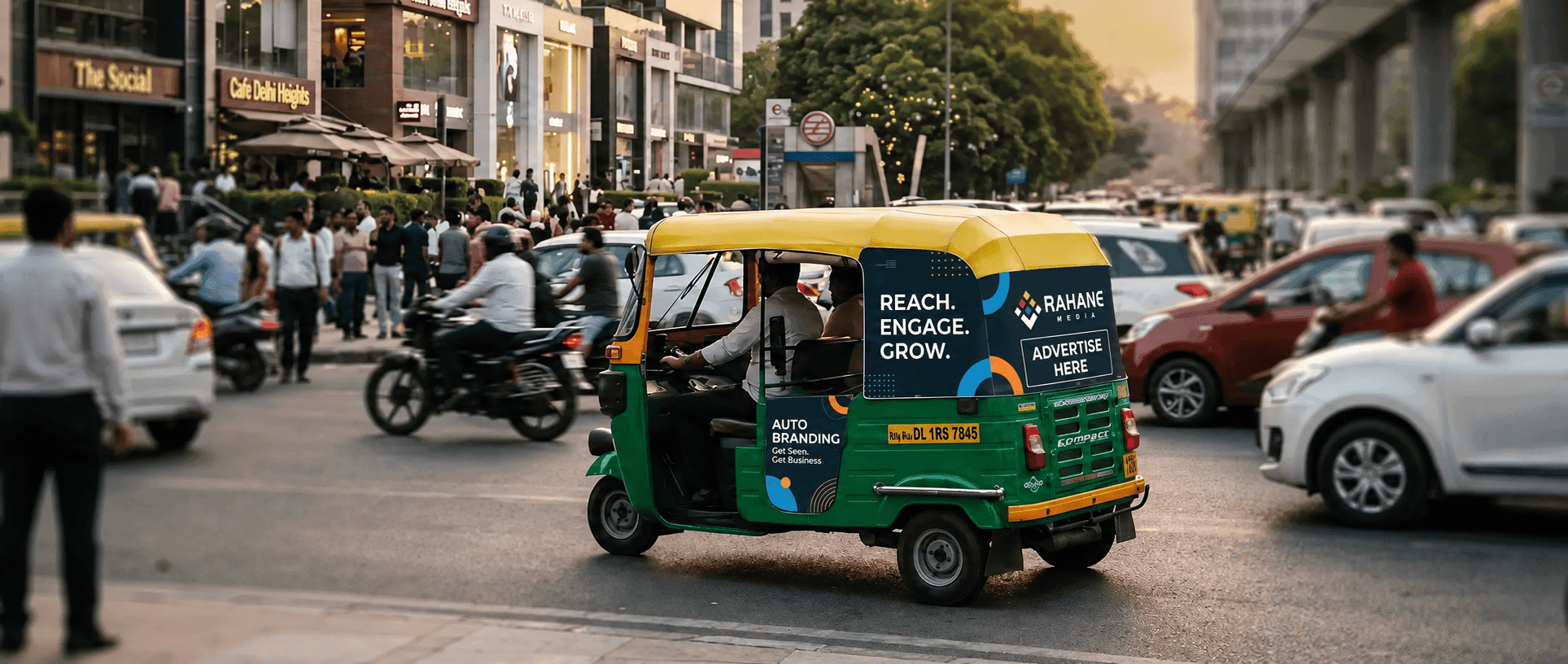
Auto Branding That Drives Real Visibility and Turns Traffic into Customers
Your audience doesn’t stay in one place—so why should your advertising? Learn how auto branding captures attention wherever the road takes it.
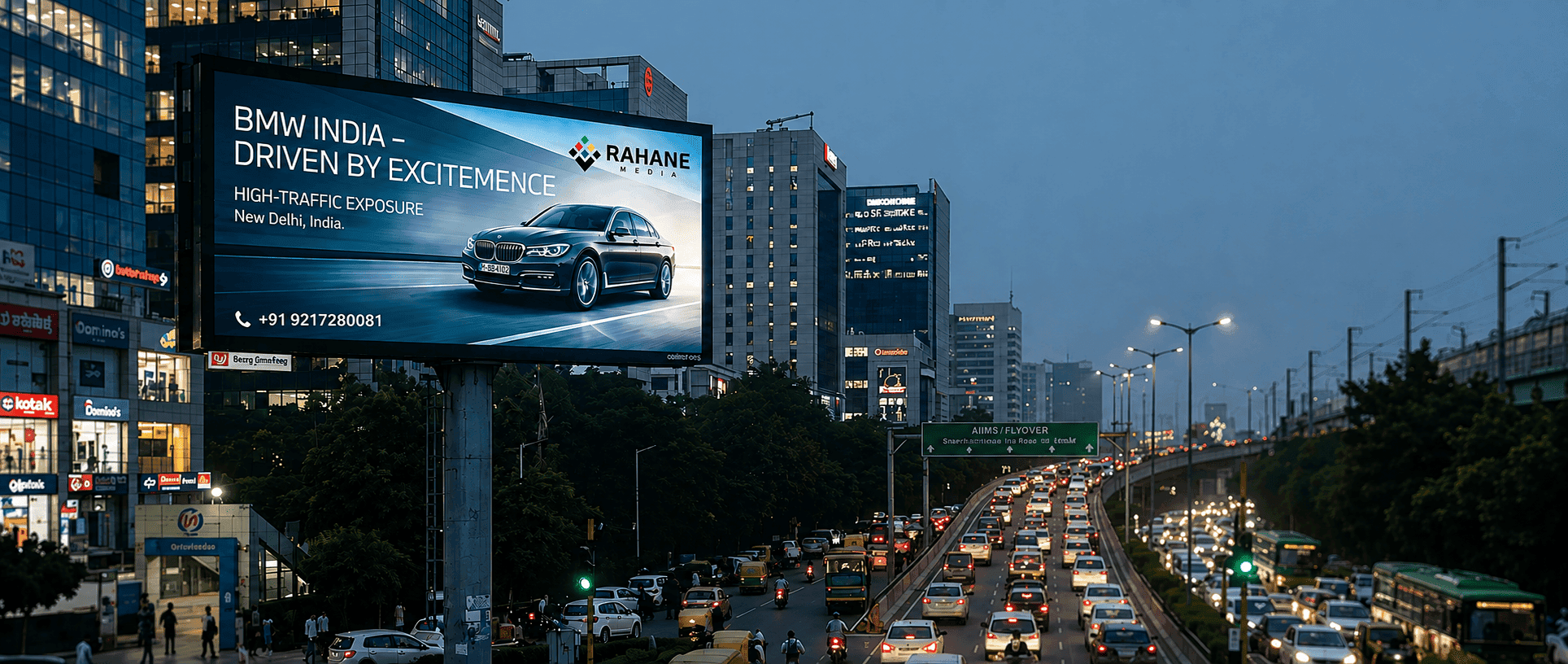
Hoarding Advertising That Puts Your Brand Where It’s Seen, Remembered, and Trusted
Your audience is already out on the streets every day — the question is, is your brand visible enough to stay in their mind? Discover how strategic hoarding advertising can turn everyday traffic into lasting brand recall and trust.
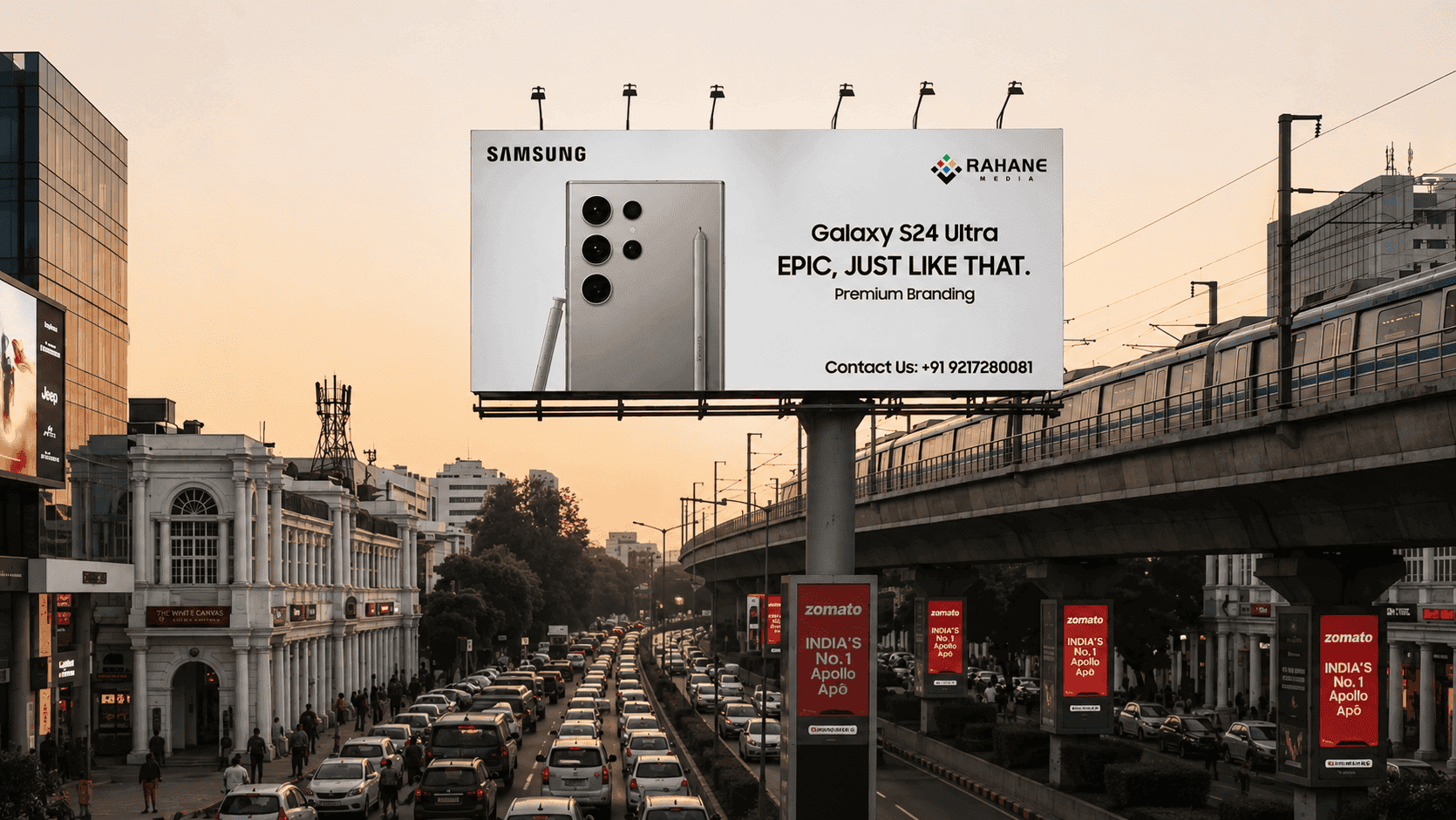
Billboard Advertising That Turns Visibility Into Real Brand Impact
Every day, thousands of potential customers pass through roads, highways, and city intersections — the question is, are they seeing your brand there? Explore how billboard advertising creates constant visibility that builds trust, recall, and long-term business presence.
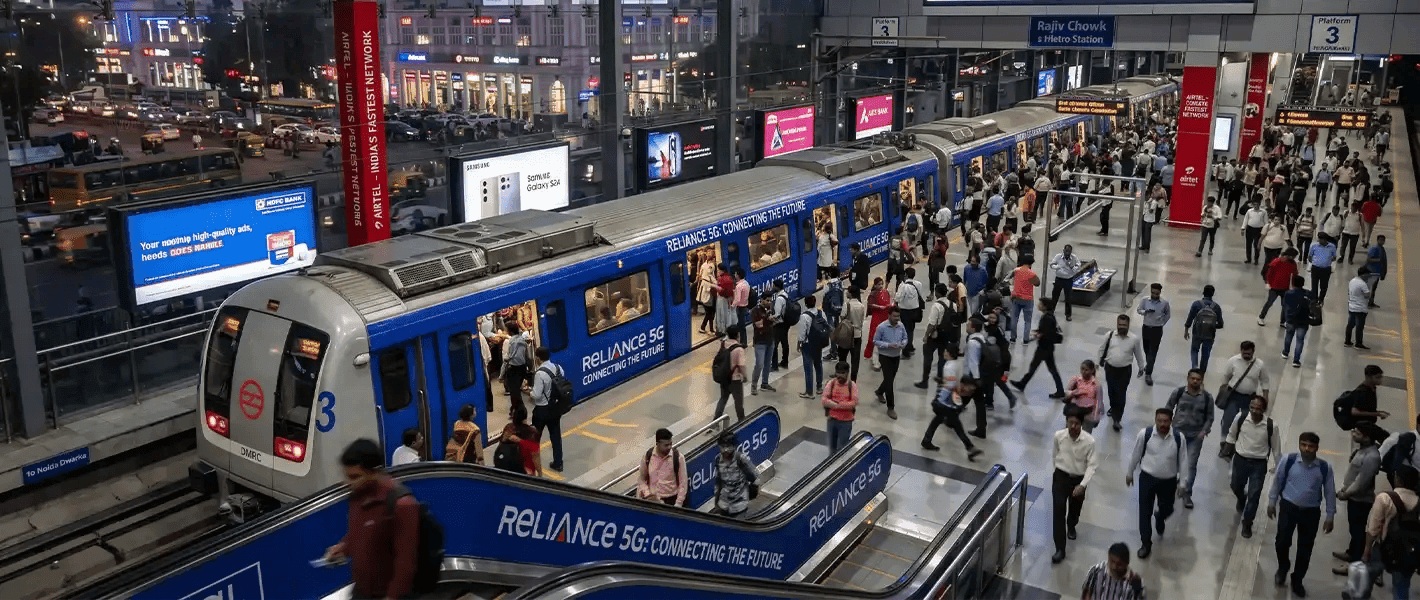
Metro Advertising: Costs, Benefits & Best Performing Ad Formats
Here’s everything you need to know about how metro advertising works, what it costs, and why brands are investing heavily in it.
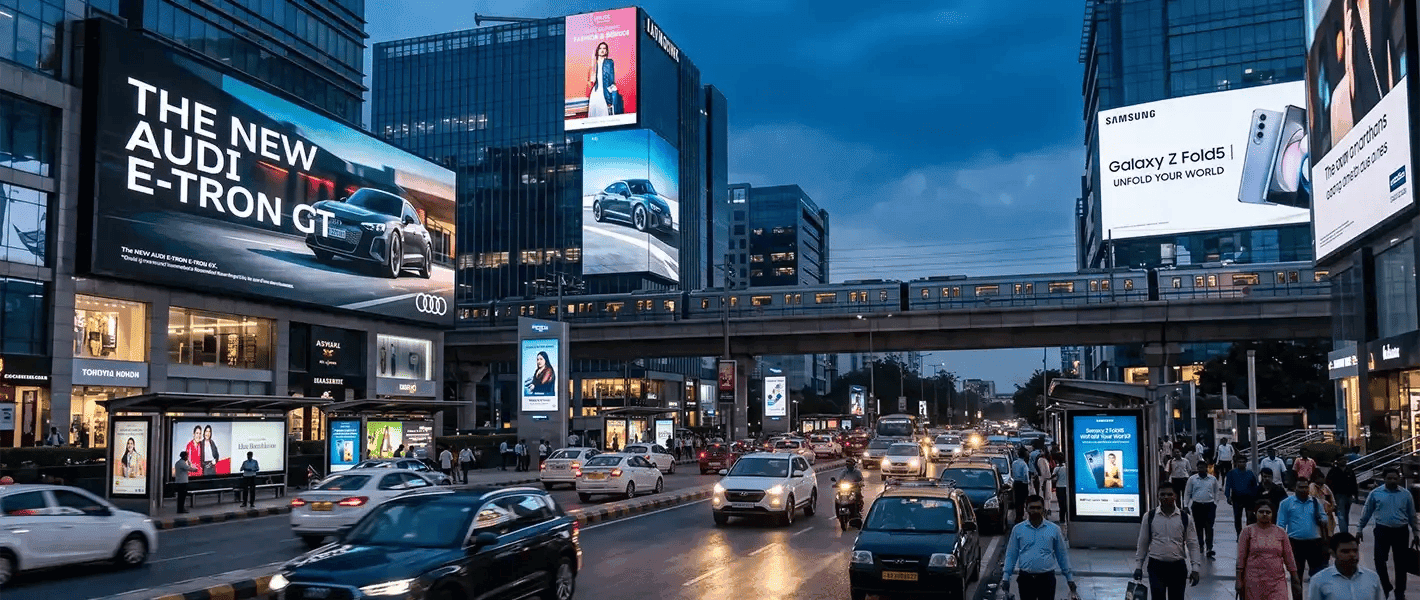
DOOH Advertising: What It Is, How It Works, and Why It Drives Real Results
Explore how DOOH advertising works, why it’s becoming a key part of modern marketing strategies, and how brands can use the right locations, formats, and creatives to drive stronger visibility and audience engagement.
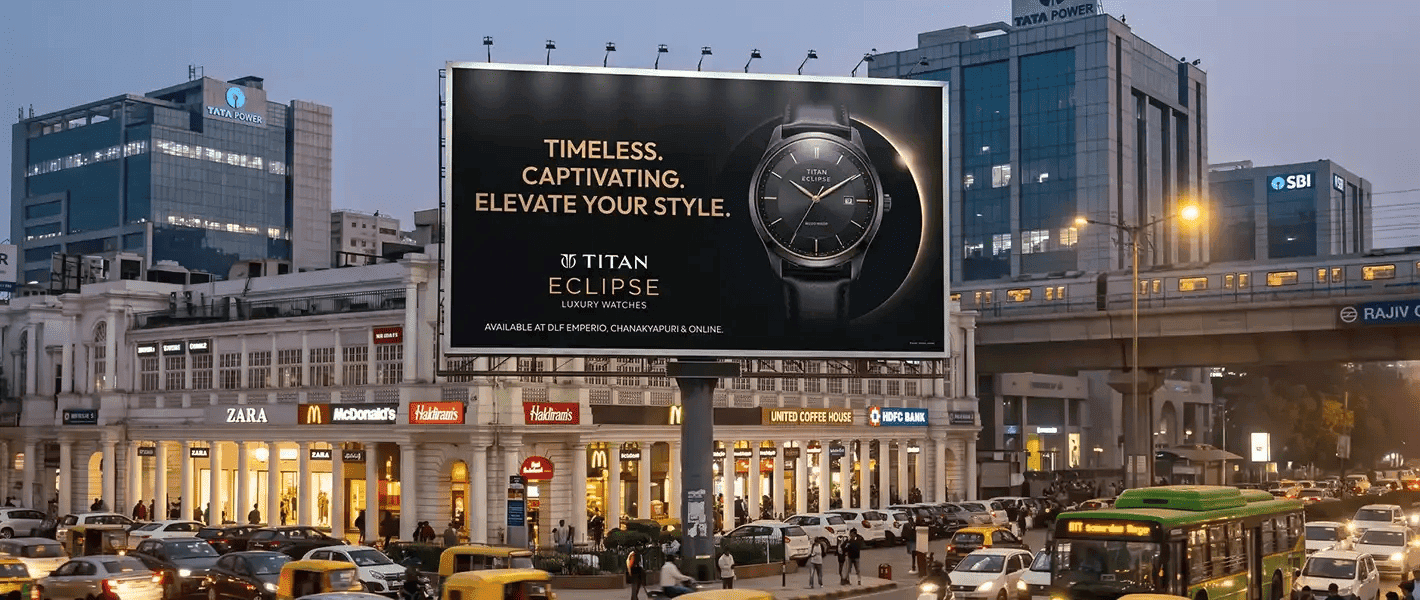
OOH Ads Explained: What Outdoor Media Is, How It Works and What It Costs
You can block a digital ad. You can skip a YouTube video. But you can't ignore a billboard on your morning commute. That's the quiet power of OOH advertising — and this guide breaks down exactly how it works.
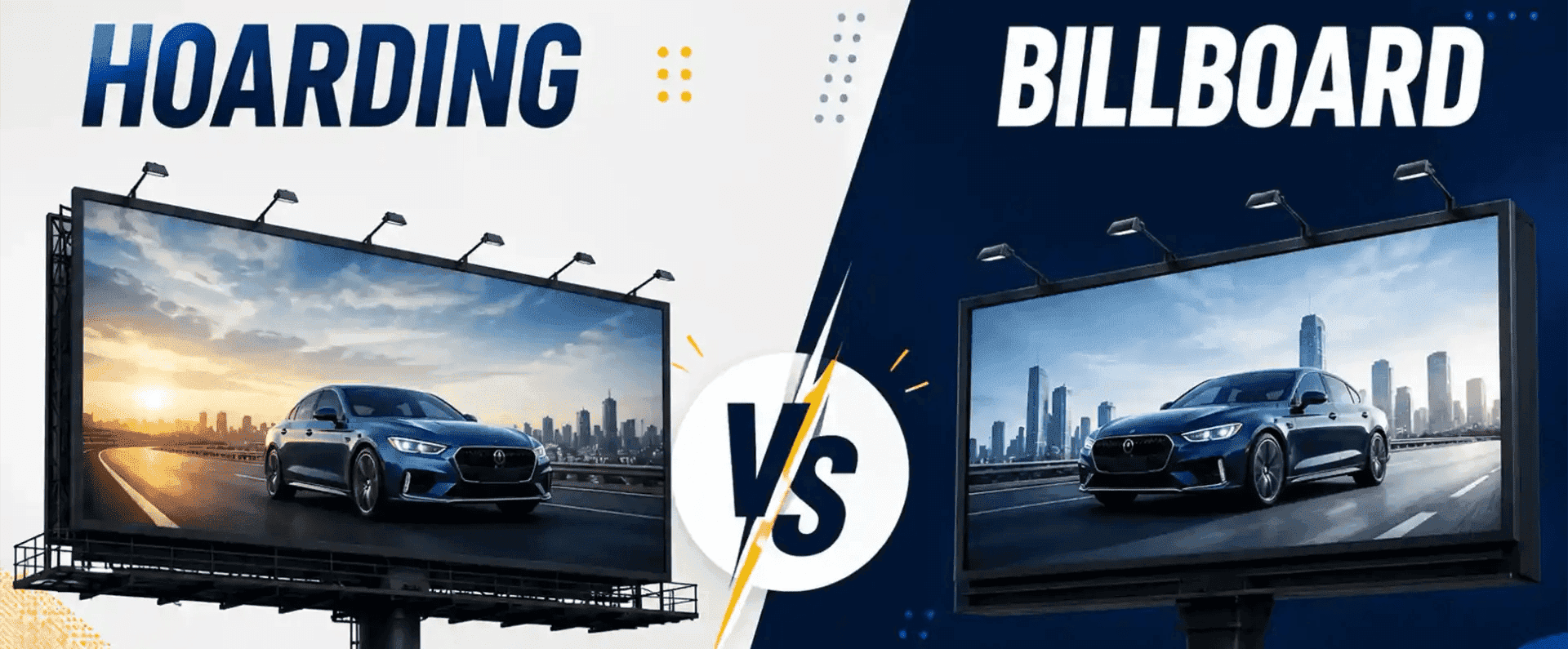
Hoarding vs Billboard: The Complete Guide for Indian Businesses (2026)
Planning an outdoor campaign in India? Before you book a single site, you need to know the difference between a hoarding and a billboard — it could save you lakhs in wasted ad spend.
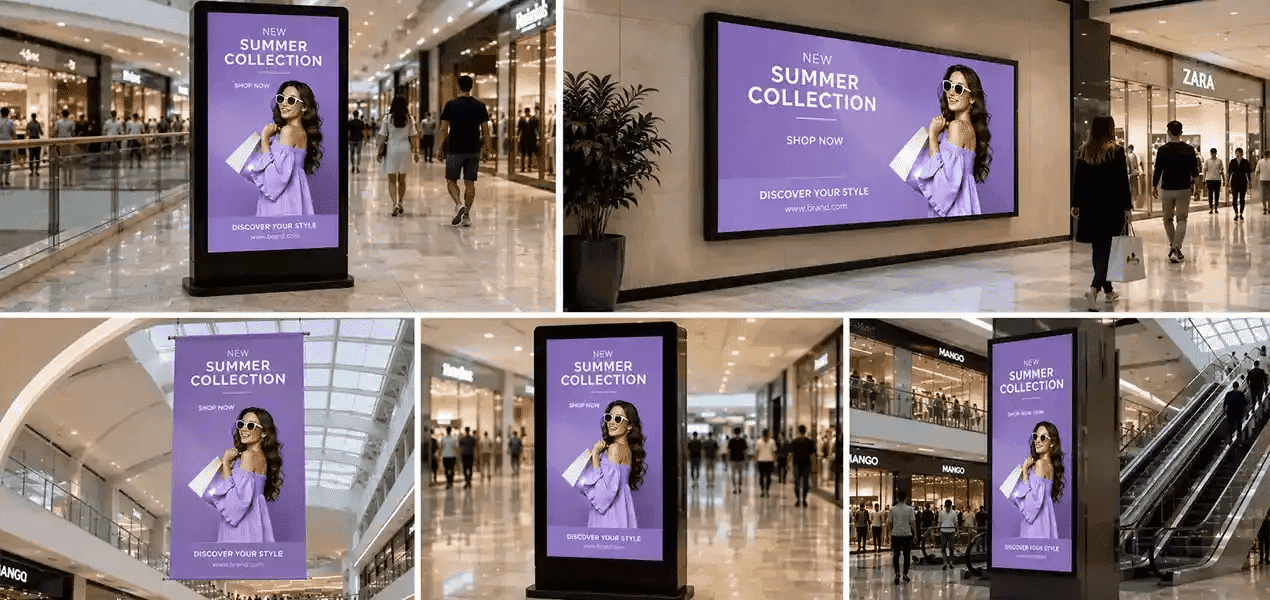
Mall Media Advertising Explained: Formats, Best Practices, and Results in 2026
Mall media advertising helps brands reach shoppers when they are most likely to make purchasing decisions. Explore advertising formats, costs, ROI opportunities, and how Rahane Media delivers campaigns that drive measurable results.